
No products in the cart.
WHAT IS SATILYN?
Satilyn is the trade name of an Amylin Analogue Peptide developed by JN Beauty Solutions®.
WHAT IS AN AMYLIN ANALOGUE?
An amylin analogue is a synthetic peptide designed to mimic the action of human amylin, a hormone naturally produced by the pancreatic beta cells. Amylin plays an important role in supporting satiety, slowing gastric emptying, and helping to stabilize post-meal blood glucose levels.
In late-stage clinical research, amylin analogues have often been studied in fixed-dose combination with semaglutide (a GLP-1 receptor agonist), known as CagriSema, to explore enhanced support for weight management through complementary biological mechanisms.
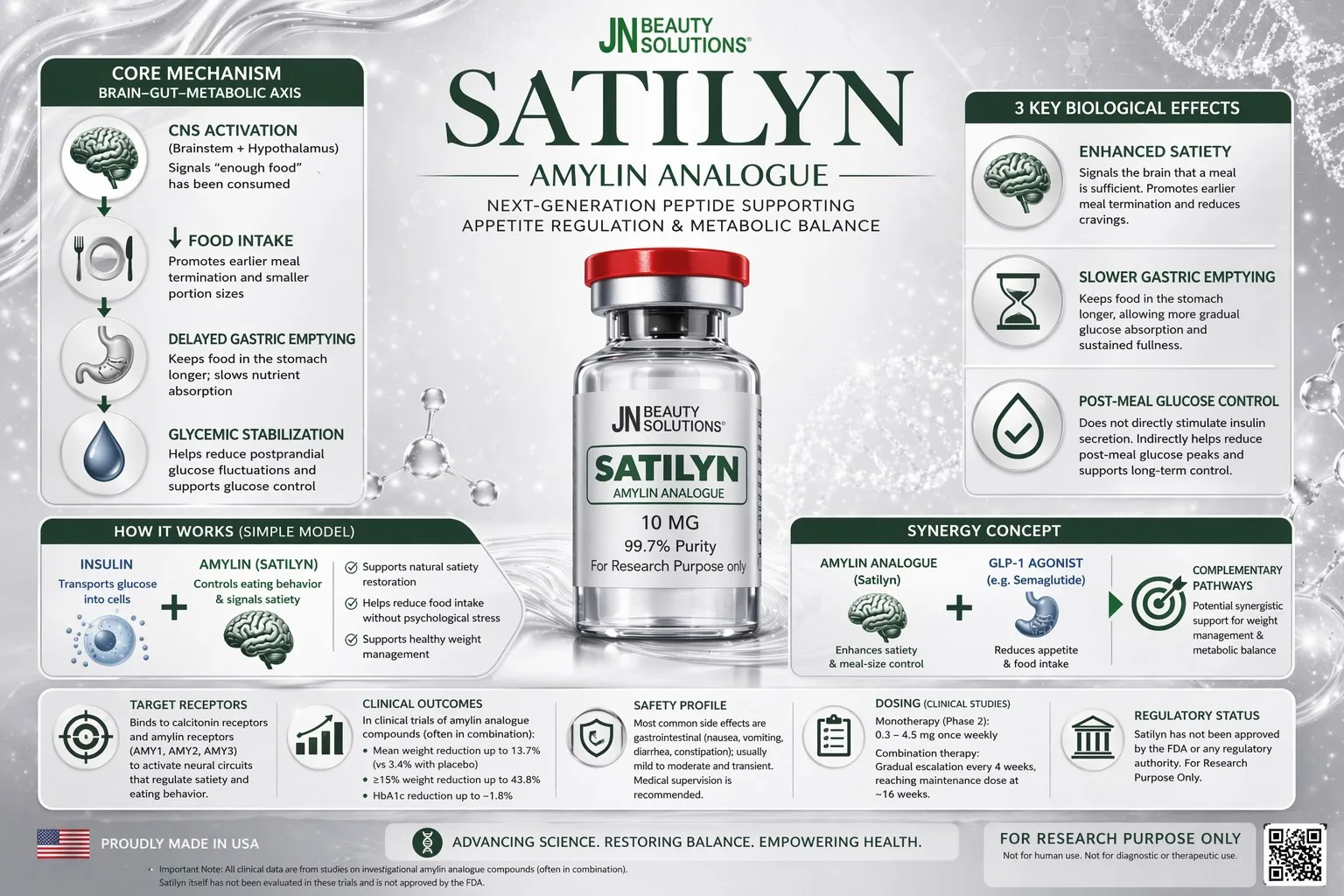
MECHANISM OF ACTION (BIOLOGICAL PRINCIPLES)
Amylin is a hormone co-secreted with insulin from pancreatic beta cells after meals. It contributes to:
- Supporting satiety
- Slowing gastric emptying
- Helping reduce postprandial glucose fluctuations (partly by moderating food intake and nutrient absorption)
WHAT EXACTLY IS AN AMYLIN ANALOGUE? (SIMPLE EXPLANATION)
When you eat:
- Insulin helps transport glucose into cells
- Amylin signals the brain that “enough food has been consumed”
→ Insulin primarily regulates blood glucose
→ Amylin supports the regulation of food intake
For decades, medical research focused mainly on insulin, while amylin was considered a secondary hormone. Modern studies suggest that individuals with overweight or obesity may have impaired amylin signaling, which can contribute to increased food intake.
This represents an important shift in understanding Amylin as a potential next-generation target for supporting healthy weight management.
Importantly, amylin primarily acts on the central nervous system — specifically the brainstem (area postrema and nucleus tractus solitarius) and the hypothalamus — rather than solely in the gut. It is best understood as a central regulator of eating behavior.
CORE BIOLOGICAL MECHANISMS OF AMYLIN
Amylin supports three key mechanisms:
- Enhancement of Satiety
Signals the brain that a meal is sufficient
Promotes earlier meal termination
Supports smaller portion sizes
- Slowing of Gastric Emptying
Keeps food in the stomach longer
Allows more gradual glucose absorption
Helps stabilize post-meal blood glucose
- Stabilization of Postprandial Glycemia
Does not directly stimulate insulin secretion
Indirectly helps reduce post-meal glucose peaks
Supports longer-term glucose control
WHAT HAPPENS WHEN AMYLIN SIGNALING IS IMPAIRED?
When amylin signaling is deficient or resistant, people may experience:
- Delayed satiety
- Difficulty stopping eating
- Increased tendency to overeat
- Greater postprandial glucose fluctuations
This can contribute to a biological cycle related to weight gain.
WHY IS AMYLIN IMPORTANT FOR WEIGHT MANAGEMENT SUPPORT?
Rather than forcing weight loss, amylin analogues are designed to help restore natural physiological satiety signaling. This may allow the body to naturally reduce food intake without creating psychological stress or false hunger signals.
WHY IS THE COMBINATION OF AMYLIN + GLP-1 CONSIDERED A PROMISING APPROACH?
- GLP-1 receptor agonists help reduce appetite
- Amylin analogues support enhanced satiety and meal-size control
These two distinct hormonal pathways may work synergistically. This scientific foundation underlies research into combinations such as CagriSema and other multi-hormonal approaches in weight management.
WHICH RECEPTORS DOES THE AMYLIN ANALOGUE TARGET?
Amylin analogues bind to calcitonin receptors and amylin receptors (AMY1, AMY2, AMY3), activating neural circuits that help regulate satiety and eating behavior.
Observed Outcomes from Clinical Studies (on Amylin Analogue Compounds)
Important Note: All data below come from clinical trials on investigational amylin analogue compounds (often studied in combination). Satilyn itself has not been evaluated in these trials and is not approved by the FDA.
- A) Phase 2 study in overweight/obese individuals without diabetes (26 weeks):
Once-weekly subcutaneous administration
Mean weight reduction of approximately 6.0–10.8% (depending on dose) vs ~3.0% with placebo
Compared with liraglutide 3.0 mg daily
- B) REDEFINE 2 Phase 3 trial (68 weeks, overweight/obese individuals with type 2 diabetes):
Mean weight reduction: -13.7% vs -3.4% with placebo
≥5% weight reduction: 83.6% vs 30.8%
≥15% weight reduction: 43.8% vs 2.4%
≥20% weight reduction: 22.9% vs 0.5%
HbA1c reduction: -1.8% vs -0.4%
Additional improvements in systolic blood pressure and selected metabolic markers
- C) REDEFINE 1 Phase 3 trial (non-diabetic obesity):
Results published in the New England Journal of Medicine (2025) demonstrated strong efficacy of the GLP-1 + amylin analogue combination approach in supporting weight reduction.
Dosing Information (from Clinical Trials – Not Recommendations for Use)
Monotherapy (Phase 2): 0.3 – 4.5 mg once weekly
Combination therapy: Starting dose low, with gradual escalation every 4 weeks, reaching maintenance dose after approximately 16 weeks
SAFETY & ADVERSE EVENTS (FROM CLINICAL DATA)
The most common side effects are gastrointestinal in nature (nausea, vomiting, diarrhea, constipation). These are usually mild to moderate, occur mainly during dose escalation, and tend to be transient.
In the REDEFINE 2 trial:
- GI events: 72.5% vs 34.4% (placebo)
- Discontinuation due to adverse events: 8.4% vs 3.0%
Rare events of interest included pancreatitis and gallbladder-related issues. Severe hypoglycemia was uncommon and mainly seen in patients using insulin or sulfonylureas.
Medical supervision is strongly recommended.
REGULATORY STATUS
Satilyn has not been approved by the U.S. Food and Drug Administration (FDA).
It is currently intended for research and educational purposes only. Novo Nordisk submitted regulatory filings for CagriSema (amylin analogue + semaglutide) in late 2025. Approval decisions are pending and not guaranteed.
The Most Important Scientific Message
“Overweight and obesity are not simply failures of willpower — they often involve disruptions in biological satiety signaling.” Supporting healthy amylin signaling may help restore the body’s natural “stop-eating” point.
IMPORTANT LEGAL DISCLAIMER
- Satilyn has not been evaluated or approved by the FDA. This product is not intended to diagnose, treat, cure, or prevent any disease, including obesity or diabetes.
- All information provided is for educational and scientific reference purposes only. Individual results may vary.
- Always consult with a qualified healthcare professional before using any peptide or supplement. JN Beauty Solutions® does not provide medical advice.
For more product information, please contact
JN Beauty Solutions®
Beauty From Science
#JNBeautySolutions #BeautySolutionsUSA #Satilyn #AmylinAnalogue #WeightManagementSupport
